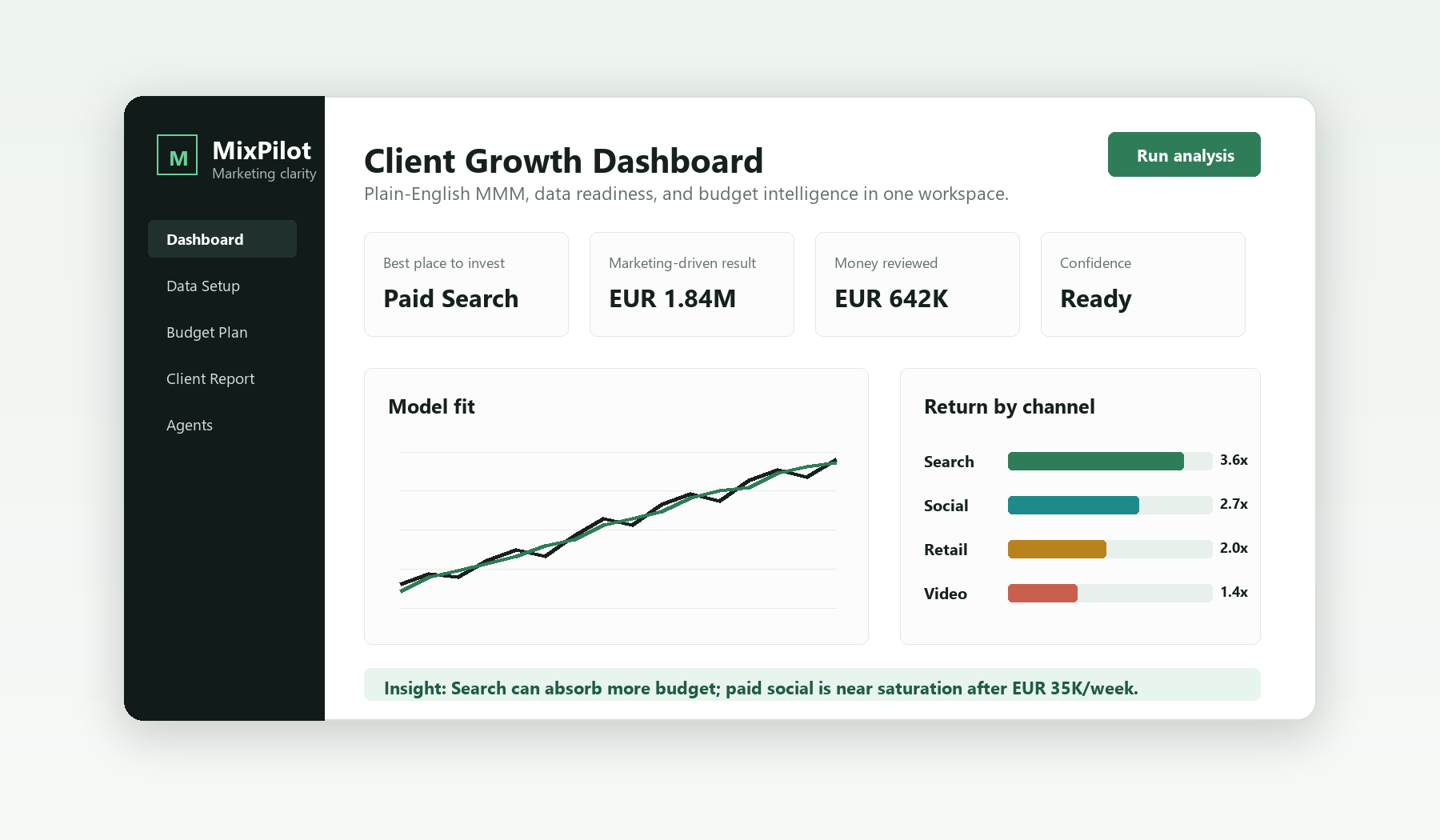
MixPilot dashboard preview showing MMM results, budget intelligence, and channel return charts

Powered by Agentic AI

Make Budgets, Not Guesswork.

MixPilot measures marketing impact, explains what changed, and guides the next best budget move across channels.
Built for modern growth teams
MMM Budget AI Meridian-ready Vertical templates Board reports
01 Measure marketing ROI in plain English
02 Optimize spend before budget is committed
03 Explain confidence, gaps, and next actions
+18% budget headroom in Search 35k/week Meta saturation point 104 weeks mature MMM input 6 agents checking data quality ROI contribution and marginal return +18% budget headroom in Search 35k/week Meta saturation point 104 weeks mature MMM input

Product

Marketing mix modeling software that explains itself

MixPilot helps teams collect weekly business data, validate quality, run MMM, measure marketing ROI, and translate the result into clear budget moves.

01

Data connectors

Google Ads, Meta, TikTok, LinkedIn, Shopify, GA4, Amazon, CRM, Google Sheets, and CSV upload.

02

Automated MMM

Fast preview MMM now, with Meridian and PyMC-Marketing production paths prepared for Bayesian media mix modeling validation.

03

Budget simulator

Run budget optimization scenarios and test what happens when spend moves between channels before the money is committed.

04

Confidence layer

Data quality, missing variables, model readiness, and plain-English warnings before results are shared.

Use cases

MMM use cases for growth teams, agencies, founders, and CMOs

MixPilot is built for teams that need a practical alternative to black-box attribution, spreadsheet reporting, and expensive consulting-only marketing mix modeling projects.

Growth teams

Marketing ROI and channel contribution

Measure how paid search, paid social, video, retail media, promotions, pricing, and seasonality contribute to revenue, leads, orders, subscriptions, or profit.

Agencies

Client-ready MMM reporting

Move from platform reporting to marketing effectiveness analysis, media mix recommendations, budget scenarios, and executive-ready performance narratives.

Founders

Board-level budget confidence

Understand which channels are driving growth, where spend may be saturated, and what budget changes should be tested next.

CMOs

Privacy-safe measurement strategy

Use MMM alongside attribution, incrementality testing, and platform reporting to plan spend without depending on user-level tracking or third-party cookies.

Why MMM

A privacy-safe alternative to fragile attribution

Marketing attribution often breaks when journeys are fragmented across devices, channels, retailers, offline media, and privacy-restricted platforms. Marketing mix modeling looks at aggregate business outcomes over time, making it useful for brands that need a broader view of marketing effectiveness.

MixPilot helps teams prepare clean MMM inputs, understand model readiness, compare channel contribution, estimate marketing ROI, and plan budget changes using response curves, marginal ROI, and business constraints.

Production MMM standard

Built to move from preview modeling to decision-grade MMM

MixPilot separates fast preview runs from production modeling. Mature clients should move through Meridian, posterior diagnostics, calibration evidence, and scenario testing before recommendations are used in budget decisions.

Engine

Meridian production path

Meridian is the default production engine for mature clients, with full posterior sampling enabled for production-grade runs.

Evidence

Channel priors and calibration

Business knowledge, lift tests, geo experiments, and platform experiments feed channel priors and calibration notes.

Structure

Geo-aware modeling

Markets, regions, stores, and product scopes are preserved where data exists instead of forcing every model into one national view.

Media effects

Reach, frequency, carryover

TV, YouTube, Meta, and video channels can be modeled with reach/frequency support, short-term response, and longer carryover effects.

Testing

Candidate model comparison

Multiple adstock, saturation, and control specifications should be tested, compared, and selected using fit, diagnostics, and business plausibility.

Diagnostics

Health checks before decisions

Holdout validation, convergence diagnostics, credible intervals, baseline checks, negative baseline risk, and sensitivity analysis guard every recommendation.

Required before budget decisions
  • Full posterior sampling completed
  • Credible intervals shown for contribution, ROI, marginal ROI, and budget recommendations
  • Baseline decomposition reviewed
  • Negative baseline probability checked
  • Holdout performance and convergence diagnostics passed
  • Sensitivity analysis reviewed across model candidates

Methodology

Transparent enough to trust, simple enough to buy

MixPilot keeps the homepage focused on the measurement approach: privacy-safe MMM, Bayesian production modeling, calibration evidence, diagnostics, and budget optimization.

01

Privacy-safe MMM

Model business outcomes from weekly sales, spend, pricing, promotions, seasonality, and market context without relying on user-level tracking.

02

Bayesian production path

Use Meridian for mature clients, with posterior sampling, geo support, credible intervals, and model health checks before decisions.

03

Calibration and diagnostics

Bring in lift tests, priors, holdout validation, convergence checks, baseline review, and sensitivity analysis to reduce false confidence.

04

Budget optimization

Recommend spend movement from marginal ROI, response curves, uncertainty, channel constraints, and profitability where margin data exists.

Priority roadmap

The path from private beta to market-ready MMM

MixPilot should harden the model layer through real client pilots, production sampling, diagnostics, calibration, and profit-aware optimization before broad market launch.

01

Enforce real uploaded datasets only

Every run should resolve to a validated tenant upload or approved dataset, with no silent sample-data fallback.

02

Enable full Meridian sampling

Production clients should run sampled Bayesian models with posterior outputs, credible intervals, and convergence checks.

03

Add model diagnostics to the UI

Expose readiness, holdout fit, convergence, baseline plausibility, negative baseline risk, and channel sanity checks.

04

Add calibration priors from lift tests

Use geo lift, conversion lift, incrementality tests, and business priors to calibrate channel effects.

05

Add geo-level modeling

Support markets, regions, stores, and product scopes wherever the uploaded data contains enough variation.

06

Run multiple model candidates

Compare adstock, saturation, control sets, priors, and geo structures before selecting the final model.

07

Optimize budget on profit

Move from revenue-only allocation to margin-aware, constraint-aware budget recommendations.

08

Export executive reports

Generate board-ready summaries with assumptions, confidence ranges, diagnostics, and recommended next experiments.

Pilot learning loop

Use pilot results to tune priors, defaults, model readiness thresholds, vertical templates, and recommendation confidence rules.

Vertical templates

Cross-industry engine, industry-specific inputs

MixPilot should not launch as one generic model for everyone. The engine can be modular underneath, while each client starts from a vertical template that asks for the variables that actually matter in their market.

Industry Important variables
E-commerce Paid search, Meta, TikTok, email, promotions, pricing, seasonality
Retail / FMCG TV, retail media, trade promotions, distribution, price, competitors
SaaS Paid search, LinkedIn, content, webinars, sales cycle, pipeline, churn
Apps Apple Search Ads, Meta, TikTok, installs, retention, LTV
Healthcare / pharma Media, field force, seasonality, regulations, awareness metrics
Restaurants / local Geo, weather, local ads, footfall, offers
Launch focus

Start go-to-market with E-commerce and Retail / FMCG. Keep SaaS, Apps, Healthcare, and Local templates available as modular expansion paths.

MMM playbook

Know when MMM is the right decision tool

Use this playbook to decide whether marketing mix modeling fits the business question, prepare the right data, choose the right model type, and translate results into budget moves.

Use MMM when
  • Marketing runs across several channels.
  • Sales, revenue, leads, or subscriptions are tracked over time.
  • Offline media, privacy limits, or fragmented journeys make user-level attribution incomplete.
  • Leadership needs budget allocation, ROI, forecasting, or scenario planning.
Do not rely on MMM alone when
  • The team needs daily bid, keyword, or creative optimization.
  • There is very little historical data or almost no spend variation.
  • The business only uses one small channel.
  • The goal is exact individual customer journey attribution.
Model Best used for Watch-outs
Regression MMM Early MMM programs, explainable readouts, fast directional learning. Less flexible when carryover, saturation, and uncertainty matter.
Bayesian MMM Modern budget planning, uncertainty ranges, business priors, and stronger validation. Needs careful assumptions, clean data, and clear stakeholder explanation.
Time-series MMM Businesses with trend, seasonality, recurring demand cycles, and forecasting needs. Can overstate patterns if important business events are missing.
Hierarchical or geo MMM Brands, regions, stores, markets, or products that need shared learning and local decisions. Requires consistent regional or product-level data definitions.
Machine learning MMM Complex non-linear patterns where prediction is important. Harder to explain; validate carefully before using for budget decisions.

1. Frame the decision

Define the business question first: ROI, budget allocation, forecast, promotion impact, or channel mix.

2. Prepare the data

Align weekly or monthly outcome, media spend, impressions, pricing, promotions, holidays, and market context.

3. Validate the model

Check holdout accuracy, realistic channel effects, uncertainty ranges, and consistency with experiments or known events.

4. Move the budget

Use marginal ROI, saturation curves, and scenario plans to decide where the next dollar should go.

Agentic AI layer

Agents that reduce the messy work around MMM

MixPilot agents help teams request the right data, map columns, detect anomalies, prepare model runs, and draft client-ready recommendations.

Intake AgentAsks the right industry-specific questions.
Data QA AgentFlags missing weeks, spikes, duplicates, and unclear fields.
Model Runner AgentQueues validation, preview, and production model workflows.
Budget AgentTurns response curves into budget movement options.
Report AgentWrites board-ready summaries in plain English.

FAQ

Marketing mix modeling questions buyers ask first

Short answers for teams comparing MMM software, attribution tools, incrementality tests, and marketing analytics platforms.

What is marketing mix modeling software?

Marketing mix modeling software estimates how media spend, pricing, promotions, seasonality, distribution, and external factors influence business outcomes such as revenue, leads, orders, subscriptions, or profit.

How is MMM different from multi-touch attribution?

MMM works with aggregate time-series data and is useful for strategic budget allocation. Multi-touch attribution follows user-level digital journeys and is usually better for tactical campaign analysis where tracking is available.

Does MixPilot require cookies or user-level tracking?

No. MixPilot is designed for privacy-safe MMM using aggregated weekly business and media data rather than individual identity data.

Which channels can MixPilot model?

MixPilot can support paid search, paid social, video, TV, retail media, email, affiliates, organic and owned channels, promotions, pricing, and business controls where the data is available.

What data is needed for MMM?

Most production MMM projects need weekly sales or revenue, media spend by channel, promotions, pricing, seasonality, holidays, distribution, and enough historical variation to separate channel effects.

Can MMM help with budget optimization?

Yes. MMM can estimate contribution, ROI, marginal ROI, and response curves, then use constraints and scenarios to recommend where the next budget movement should be tested.

Workflow

From onboarding to decision in one flow

1

Onboard client

Set company, industry, model, currency, data period, and first checklist.

2

Collect data

Use templates or connectors to bring media, sales, pricing, promotions, and context together.

3

Validate model

Check data quality, run preview models, and prepare production MMM inputs.

4

Plan budget

Export recommendations, confidence notes, and executive-ready reports.

Launch narrow, scale wide

The first product should feel deeply tailored for one or two verticals. The platform can then reuse the same backend, agents, connectors, and MMM runners as new templates are added.

Launch: E-commerce Launch: Retail / FMCG Next: SaaS Next: Apps Later: Healthcare Later: Local

Private beta

Bring MixPilot to your next budget review

Tell us who you are and we will help set up the first workspace, template, and measurement path.

Complete the form to unlock the MixPilot app preview. Lead capture can be connected to the backend or CRM next.